Chesterton’s Fence : Industrial Decarbonization
The industrial sector is made up of a staggering number of unique processes. From manufacturing to chemical to metallurgical, the sector is considered extremely challenging to decarbonize. While any single decarbonization solution is unlikely to be portable across the entire sector, a cross cutting opportunity is the decarbonization of heat. The generation of heat accounts for most industrial sector emissions and is responsible for close to 21% of total global atmospheric emissions. [1]
Heat demand can be characterized by temperature (how hot do I need my heat source) and load (the rate of heat transfer required). The end use application will dictate both variables. This is important because if the aim is to decarbonize heat, the new heat source must provide the requisite temperature and load for the end use application.
Zero-Carbon Heat Source: Instead of burning a fuel to generate heat, we can harvest it directly from the environment. Solar radiation is attractive (it is abundant and has no fuel costs), but intermittency, areal density, and achievable temperatures are an issue. Resource intermittency reduces capital utilization which drives up total costs. Existing solar installations used to drive steam power cycles for electricity, operate at maximum temperatures of 565 degrees C – roughly a quarter of the flame temperature of natural gas, hydrogen, or fuel oil. Geothermal does not suffer from intermittency, and facilities have much smaller land footprints than solar. However, reservoirs are not widely distributed and generate temperatures between 100-150 degrees C; insufficient for most indusial heat demand.
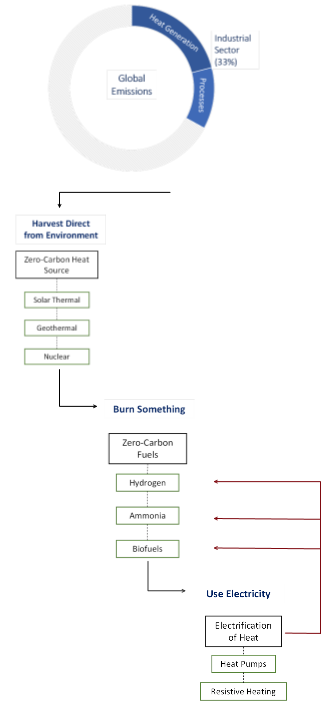
Zero-Carbon Fuels: Burning gas, coal or oil is the primary method for heat production today. Hydrogen, ammonia, and biofuels are alternative fuel sources that when burned produce little to no emissions. Hydrogen produces water when burned, ammonia produces nitrogen. Industry has extensive experience with these fuels as feedstock but less experience burning them directly for heat. To be adopted as an industrial fuel, it must be produced cost effectively at scale using zero emission technology. Direct fuel substitution is possible, but there are a few exceptions. For some processes, hydrocarbon fuels not only provide heat, but serve as a reactant as well. Steel production is a good example: in a blast furnace, coking coal is used to create heat, but the carbon monoxide byproduct is the main agent to covert iron oxide to iron. Even if the cost of producing alternative fuels from renewable resources becomes cost effective, direct fuel substitution for heat generation only applies to end-use applications that do not rely on hydrocarbon byproducts in their process.
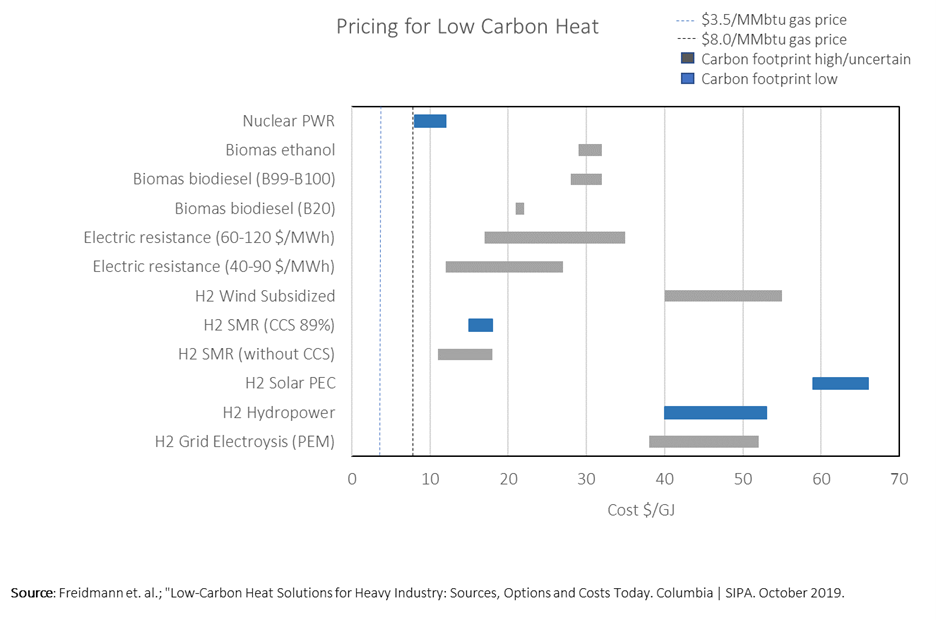
Electrification of Heat: We can also generate heat from electricity. For most industrial users, electricity costs exceed fossil fuel costs. Thus, any alternative requires the heat output per unit of electrical input to be >1 to be cost competitive. This is why hydrogen production using renewable electricity as a generation source is 2-3x more expensive than using natural gas. If electricity costs do not fall below fossil fuel costs, electrified heating technologies must gain proportionally in efficiency.
Heat pumps are an attractive solution here. Unlike resistive heating, one unit of electricity can result in more than one unit of useful heat. Heat pumps however have high up-front capital costs relative to boilers which translates into significantly longer payback periods. Additionally, industrial heat pumps today can only supply heat up to 180 degrees C, and rarely in excess of 1 MW of capacity.
At a large scale, or a network level, complete electrification of heat requires a massive increase in electrical transmission. In the United States, roughly double the electricity would need to be running through the wires to meet industrial thermal energy demand alone (it would be an order of magnitude more if you include say any penetration of EV’s or transportation electrification).
These challenges are not insurmountable. But they are nonetheless real.
- Some applications, like steel, will have more difficulty accepting fuel substitution.
- All options will substantially increase the production cost and wholesale price of industrial products.
- Most substitutes today are technically more challenging and more expensive than carbon capture and storage (CCS). CCS is not without its costs and documented challenges, but it is actionable today, and has the added benefit of capturing emissions from by-product processes, but just carbon emissions from heat.
The hydrogen hype is not without merit; combusting hydrogen is likely the readiest source of heat across all options (its use cases relative to minimizing the levelized cost of heat). However, promise today lies in reforming natural gas and decarbonizing with CCS (blue hydrogen). It has the best cost profile, most mature supply chain and would add ~10-50% of wholesale product costs. Importantly, it would provide a pathway to substitute hydrogen produced by electrolysis of water from carbon free electricity (green hydrogen). Today however, if implemented, carbon free hydrogen would increase wholesale production costs by 200-800%.
Chesterton’s Fence is the principle that reforms should not be made until reasoning behind the existing state of affairs is understood. Industrial literacy, while a self-explanatory term, has been discussed prominently by The Roots of Progress, a website dedicated to the history of technology and industry, and the philosophy of human progress.
[1] In the U.S., just under 30% of heat is generated to make steam, the remainder is used directly in furnaces, ovens, or other unit operations.